
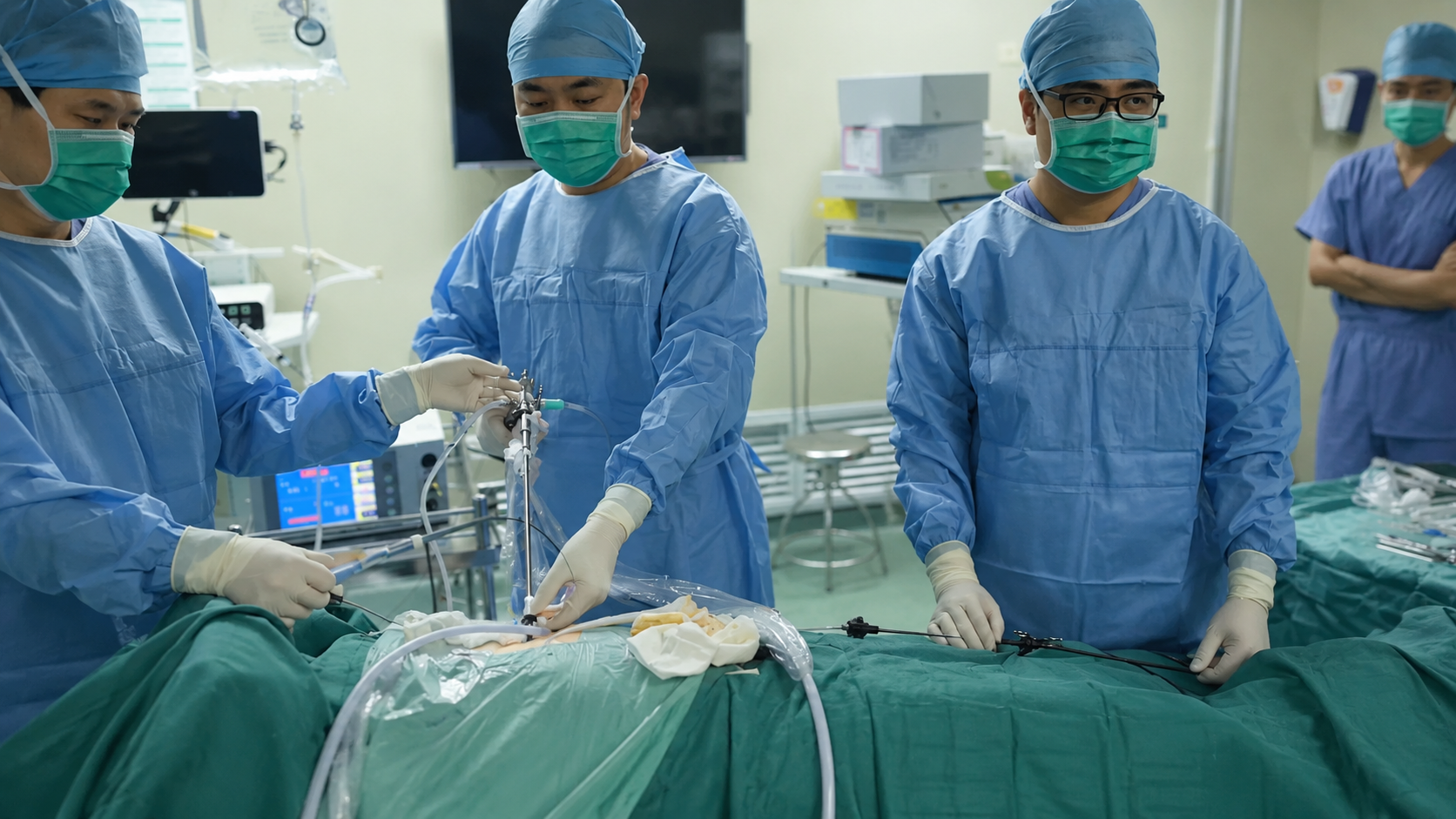
For a long time in the past, surgical laparotomy for choledocholithotomy was the main method to treat common bile duct stones.
With the development of digestive endoscopy technology, many patients with common bile duct stones can now undergo stone removal via ERCP , which means entering the digestive tract through the mouth to complete endoscopic bile duct stone removal, biliary drainage, stent placement, and other treatments.
Dr. Wang Xiaoliang, from the Department of Hepatobiliary Surgery at Pudong Hospital Affiliated to Fudan University in Shanghai, after years of clinical research, has performed oral common bile duct stone removal via ERCP without damaging the sphincter of Oddi, relieving the suffering of many patients with common bile duct stones.
What are Common Bile Duct Stones?
Common bile duct stones refer to stones located in the common bile duct. The common bile duct is an important passage for bile excretion. If stones appear here, they may affect bile drainage, leading to a series of symptoms and complications.
Based on their origin, common bile duct stones can be divided into two categories:
01
Primary Common Bile Duct Stones
The stones form within the extrahepatic bile ducts. In this case, the patient's gallbladder may not necessarily contain stones.
02
Secondary Common Bile Duct Stones
Stones from the gallbladder pass into the common bile duct. Their shape and nature are mostly the same as those of the gallbladder stones.
Symptoms of Common Bile Duct Stones
The manifestations of common bile duct stones vary greatly, and the severity mainly depends on the degree of bile duct obstruction and whether there is a concurrent biliary infection.
- Upper abdominal pain: especially after eating greasy foods.
- Jaundice: May present as yellowing of the skin, yellowing of the eyes, and dark urine; prolonged obstruction may also develop into biliary cirrhosis.
- Biliary tract infection: Patients may experience upper abdominal colic, fever, and jaundice; in severe cases, it may progress to acute obstructive suppurative cholangitis.
- Biliary pancreatitis: Biliary obstruction and inflammation may also induce pancreatitis, and some patients may develop severe acute pancreatitis.
Severe infection can be life-threatening
If the biliary tract infection continues to worsen, the patient may develop septic shock. The condition can progress rapidly, requiring prompt relief of the biliary obstruction and infection control.
Treatment methods for common bile duct stones
Currently, treatment methods for common bile duct stones mainly include two categories: surgical stone removal and endoscopic stone removal.
In the past, open surgical choledocholithotomy was an effective treatment, but open surgery involves significant trauma and slower recovery; some patients may also require a biliary drainage tube for a period of time.
For elderly, frail, or patients with poor baseline health, traditional surgery is poorly tolerated and may not even be an option.
ERCP allows doctors to access the bile duct and remove stones and provide drainage without making an abdominal incision.
With advances in GI endoscopy, hepatobiliary surgeons have gradually developed a minimally invasive method for removing common bile duct stones without open surgery, known as endoscopic common bile duct stone removal, or ERCP.
What is ERCP?
ERCP is a minimally invasive treatment for biliary and pancreatic diseases performed through a digestive endoscope.
- The doctor inserts a duodenoscope, similar to a standard gastroscope, through the patient’s mouth.
- The endoscope passes through the esophagus and stomach to reach the duodenum below the stomach.
- The doctor locates the openings of the bile duct and pancreatic duct into the duodenum.
- Through this opening, the bile duct is accessed to perform contrast imaging, stone extraction, biliary drainage, or stent placement.
How can ERCP be simply understood?
ERCP does not involve making an abdominal incision to access the bile duct; instead, it enters through the mouth into the digestive tract and then accesses the biliary system through the openings of the bile and pancreatic ducts in the intestine to address the problem.
What treatments can ERCP perform?
- Remove common bile duct stones
- Perform cholangiography
- Relieve obstructed bile ducts
- Place biliary drainage stents
For patients with common bile duct stones, the doctor can use the duodenoscope to find the biliary opening and then use relevant instruments to enter the bile duct and extract the stones.
For patients with severe biliary obstruction, significant infection, or poor general condition, a biliary stent can be placed first to allow bile and purulent bile to drain, relieving the obstruction and controlling infection. Once the patient’s condition improves, endoscopic stone extraction can be scheduled for a later date.
ERCP has advantages over traditional surgery
The core advantage of ERCP is that it does not require an open abdomen and is less invasive. Compared to traditional surgery, ERCP typically offers the following features:
- No abdominal surgical incisions
- Relatively minimal bodily trauma
- Faster postoperative recovery
- Especially suitable for some elderly patients
- Suitable for patients with poor surgical tolerance
- Can address residual stones after cholecystectomy
As endoscopic stone retrieval instruments become more sophisticated and physicians' operating techniques continue to improve, endoscopic common bile duct stone removal has become one of the important treatment methods for common bile duct stones.
Which patients are more suitable for ERCP?
- Elderly patients
- Patients who are relatively frail
- Patients with poor tolerance for surgery
- Patients with residual common bile duct stones after cholecystectomy
- Patients with recurrent common bile duct stones
- Patients who cannot tolerate general anesthesia but need prompt relief of biliary obstruction
For patients with severe infection, biliary obstruction, or at risk of septic shock, ERCP can also serve as an important emergency method to relieve obstruction.
Dr. Wang Xiaoliang's Special Technique: Preserving the Sphincter of Oddi
During the stone removal process, the physician uses medication to relax the sphincter of Oddi, completing common bile duct stone extraction without cutting the sphincter of Oddi.
The sphincter of Oddi is located at the opening where the bile duct and pancreatic duct lead into the duodenum. It helps regulate the discharge of bile and pancreatic juice, and also prevents intestinal fluid from refluxing into the biliary tract.
Why should the sphincter of Oddi be preserved as much as possible?
If this structure is cut, the normal barrier function of the bile duct may be affected. In the long term, it may increase the risk of duodenal fluid reflux, recurrent cholangitis, and recurrence of common bile duct stones.
Also feasible for elderly patients with multiple underlying conditions
Clinical Case 1
An 80-year-old patient with cirrhotic ascites and massive bile duct stones
An 80-year-old elderly patient suffering from cirrhotic ascites and massive stones in both the intrahepatic bile ducts and common bile duct. Due to the cirrhotic ascites, the patient is unable to undergo hepatectomy; being of advanced age, they are also likely unable to tolerate a liver transplant.
After analyzing the location and size of the stones through imaging, Dr. Wang Xiaoliang developed a step-by-step treatment plan for the patient.
- Under ultrasound guidance, percutaneous puncture was performed to place drainage tubes approximately 2 mm in diameter in the left and right intrahepatic bile ducts.
- Establish a treatment channel between the skin surface and the intrahepatic bile ducts.
- Dilate the channel, enter with a rigid choledochoscope, and use electrohydraulic lithotripsy to break up and remove the stones.
- Treat the common bile duct stones through the channel, then combine with ERCP technology to remove the stones through the mouth.
- Use a flexible choledochoscope and an ultra-thin choledochoscope to examine the bile duct branches and clear residual stones.
The entire treatment process did not require hepatectomy, and ultimately all stones were successfully removed. The patient's appetite returned and recovery was relatively fast.
Can patients who have had gastric cancer surgery still undergo ERCP?
Yes, but the procedure becomes significantly more difficult.
Clinical Case 2
Sudden Suppurative Cholangitis and Septic Shock in a Patient After Gastric Cancer Surgery
A 78-year-old patient, who had previously undergone radical gastrectomy for gastric cancer, later developed high fever, abdominal pain, and distension due to common bile duct stones. CT examination confirmed common bile duct stones. The patient's blood pressure dropped to 70/40 mmHg, presenting classic manifestations of suppurative cholangitis that progressed to septic shock.
Because the patient had previously undergone radical gastrectomy and also had liver metastases, open surgery under general anesthesia was not tolerated. The medical team therefore chose to perform ERCP via the oral route.
After radical gastrectomy, the patient’s gastrointestinal anatomy had been altered, making conventional ERCP relatively difficult. Based on previous surgical records, the team determined the anatomy and decided to perform ERCP using a colonoscope.
Under colonoscopy, the doctor accurately identified the afferent loop of the small intestine, smoothly reached the duodenal papilla, inserted a guidewire, and placed a plastic stent, after which purulent bile immediately drained.
The day after the procedure, the patient's temperature normalized. One week later, the doctor successfully removed the stones through another colonoscopic ERCP.
Is ERCP Completely Risk-Free?
Although ERCP does not require opening the abdomen, it remains a highly specialized minimally invasive endoscopic treatment. Physicians need to make a comprehensive judgment based on the patient’s condition, stone location, biliary anatomy, previous surgical history, and other factors.
Especially for patients who have undergone gastrointestinal reconstruction surgery, their gastrointestinal anatomy has been altered, which significantly increases the difficulty of ERCP and places higher demands on the doctor’s clinical experience and endoscopic skills.
Professional Evaluation Is Required Before Treatment
Whether ERCP is suitable, which stone extraction method to use, and whether a biliary stent should be placed first should be determined by a hepatobiliary surgeon or gastroenterologist with relevant experience.
Don’t Delay Treatment for Common Bile Duct Stones
The danger of common bile duct stones lies not only in pain, but also in the potential to block the bile duct, causing jaundice, biliary tract infection, biliary cirrhosis, and gallstone pancreatitis.
When complicated by acute obstructive suppurative cholangitis, the condition can progress rapidly and may even lead to septic shock in severe cases.
Therefore, once common bile duct stones are detected, timely medical evaluation should be sought. The priority of treatment is to remove the stones as early as possible, relieve biliary obstruction, and control any existing infection.
The content of this article is for health education only and should not be used as a substitute for in-person doctor consultations, imaging examinations, or individualized treatment advice.