
Dr. Wang Xiaoliang – Single-Incision Gallbladder-Preserving Stone Removal
Gallstones: Is Gallbladder Removal Always Necessary? – An Innovative Minimally Invasive Surgery: Single-Incision Gallbladder-Preserving Stone Removal
Gallstones are a common disease worldwide, with a trend toward younger patients. In the past, treatment almost always involved removing the gallbladder, leading many patients to wonder: Is gallbladder removal really necessary?
Not necessarily. Dr. Wang Xiaoliang, from the Department of Hepatobiliary Surgery at Shanghai Fudan University Affiliated Pudong Hospital, has significantly advanced the technique of stone removal from the gallbladder through decades of clinical research.
Treatment of gallstones should not be simplified to “remove the gallbladder if there are stones.” Instead, it depends on whether the gallbladder is functional, whether there are symptoms or complications, and whether the patient meets the criteria for gallbladder-preserving stone removal.
The gallbladder is not a dispensable organ. It primarily stores, concentrates, and excretes bile to aid digestion, especially when consuming high-fat or high-protein foods. It also secretes fluid to protect the gallbladder wall and may have certain immune functions.
If the gallbladder is removed, while it prevents recurrence of gallstones, it may also lead to issues such as indigestion, bloating, diarrhea, increased incidence of common bile duct stones, higher rates of reflux esophagitis, gastritis, and duodenitis, as well as compromised biliary immune defense.
Therefore, for a well-functioning gallbladder, especially in younger patients, removal is not always necessary. In recent years, the functional surgery concept of “clearing stones while preserving gallbladder function” has gained increasing attention.
What Are the Dangers of Gallstones?
Early-stage gallstones may not cause obvious symptoms; many people discover them incidentally during ultrasound examinations. Some patients only experience dull upper abdominal pain after overeating or consuming greasy foods, which is often mistaken for stomach issues.
When a small stone becomes lodged in the neck of the gallbladder, it can cause biliary colic. The pain is usually located in the right upper quadrant or upper abdomen, may radiate to the right shoulder blade or back, and can be accompanied by nausea and vomiting. Overeating, greasy meals, or changes in body position during sleep can worsen the pain. A few patients may also develop mild jaundice.
Gallstones can also lead to cholecystitis, cholangitis, secondary bile duct stones, and in severe cases, systemic infection. Long-term chronic inflammation and stone irritation are also associated with the development of gallbladder cancer.
One particularly important complication is biliary pancreatitis. The gallbladder connects to the bile duct, and the bile duct shares a common opening with the pancreatic duct. If a small gallstone falls into the bile duct and moves to the common opening, it can block the pancreatic duct, preventing pancreatic juice from draining and triggering pancreatitis. Mild pancreatitis can be treated with fluids, but severe pancreatitis can be life-threatening.
Therefore, gallstones should not be treated with extracorporeal shock wave lithotripsy like kidney stones. Breaking stones into smaller fragments can cause them to fall into the bile duct, potentially inducing more serious problems such as cholangitis or pancreatitis.
When Should Surgery Be Considered?
Asymptomatic gallstones can be monitored with regular ultrasound and a healthy diet. However, long-term observation shows that some patients’ conditions progress, leading to symptoms or complications.
Surgery should be considered in the following situations:
- Multiple stones, or a stone diameter of 2–3 cm or larger;
- Calcification of the gallbladder wall or porcelain gallbladder;
- Concomitant gallbladder polyp larger than 1 cm;
- Gallbladder wall thickening over 3 mm;
- Significant symptoms or complications already present;
- Recurrent acute cholecystitis;
- Ineffective medical treatment with worsening condition;
- Severe conditions such as gallbladder gangrene, perforation, or diffuse peritonitis;
- Chills, rigors, high fever, or even signs of toxic shock.
For patients with symptomatic or complicated gallstones, surgery is usually the primary treatment.
What Is Gallbladder-Preserving Stone Removal?
Gallbladder-preserving stone removal involves extracting stones from the gallbladder while keeping the gallbladder intact. The core principle is to completely remove the stones while preserving a functional gallbladder.
In the past, older methods of gallbladder-preserving stone removal were considered to have a high recurrence rate, largely due to inadequate equipment such as choledochoscopes, leading to blind spots during stone extraction. Many so-called “recurrences” were actually residual stones. Modern endoscopic gallbladder-preserving stone removal uses high-magnification visualization to clearly observe the shape, size, and distribution of stones, reducing blind spots and the risk of residual stones.
The stone recurrence rate after modern endoscopic gallbladder-preserving stone removal is 2%–10%, and high-quality surgical technique can keep the recurrence rate below 5%.
What Is Single-Incision Laparoscopic Gallbladder-Preserving Stone Removal?
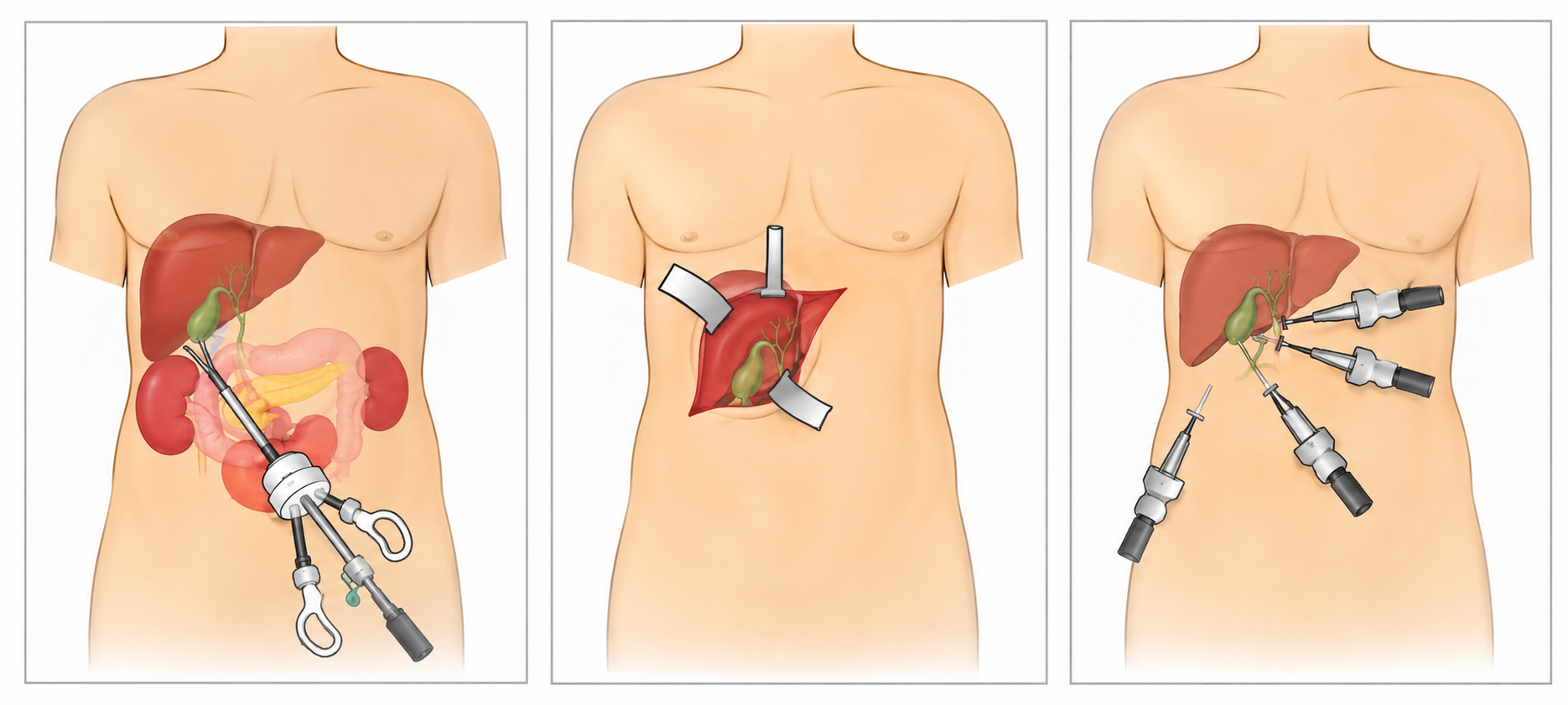
Traditional laparoscopic surgery usually requires 3 or 4 incisions in the abdominal wall. Single-incision laparoscopic gallbladder-preserving stone removal uses only one incision at the navel, typically about 2–3 cm, through which the abdomen is accessed to perform the surgery.
Because the navel has natural skin folds that can conceal the incision, the postoperative scar is very discreet, approaching a “scarless” effect. This is one of the greatest advantages of single-incision laparoscopic surgery.
Its main benefits include:
- Fewer incisions, less trauma;
- Incision hidden in the navel, excellent cosmetic result;
- Less postoperative pain;
- Faster recovery;
- Shorter hospital stay;
- Correspondingly lower hospitalization costs;
- Clear laparoscopic view with high magnification on the monitor;
- Better visualization of stone size, shape, and distribution, reducing missed or residual stones.
However, single-incision laparoscopy also has challenges. Because the camera and instruments all enter through the same umbilical channel, the instruments can be “crowded,” making the procedure more technically demanding than traditional laparoscopy and requiring greater laparoscopic skill and instrument control from the surgeon.
Who Is a Candidate for Gallbladder-Preserving Stone Removal?
Gallbladder-preserving stone removal is not suitable for all gallstone patients. It emphasizes indications and contraindications, which must be determined based on examination results.
Indications for gallbladder-preserving stone removal include:
- Gallstones confirmed by ultrasound or other imaging;
- Normal gallbladder function confirmed by ECT or oral cholecystography;
- Gallbladder not visualized on ECT, but stones can be completely removed during surgery and the cystic duct is confirmed patent;
- Other indications deemed appropriate by the hepatobiliary surgeon.
In simple terms, gallbladder-preserving stone removal is most suitable for patients whose gallbladder is still functional, the cystic duct is patent, stones can be completely removed, and there is no severe gallbladder pathology.
When Is Gallbladder-Preserving Stone Removal Not Suitable?
Contraindications include:
- Gallbladder atrophy, loss of gallbladder lumen;
- Cystic duct stones that cannot be found or removed endoscopically during surgery;
- Cystic duct obstruction confirmed by intraoperative imaging that cannot be relieved;
- Diffuse intramural stones of grade III or higher in the gallbladder;
- Gallbladder xanthogranuloma;
- Gallbladder stones with malignant transformation.
In such cases, forced gallbladder preservation is usually not appropriate. Whether to preserve the gallbladder depends not only on the patient’s wishes but also on whether the gallbladder is worth preserving and whether it is safe to do so.
Preserve or Remove: How to Choose?
The advantage of cholecystectomy is that it prevents recurrence of gallstones. Laparoscopic cholecystectomy has long been the gold standard for gallstone treatment, offering minimal trauma, small scars, and fast recovery.
However, gallbladder removal also means permanent loss of gallbladder function, which may lead to short- and long-term problems. Therefore, treatment decisions should not be “one size fits all.”
A rough guideline: If the gallbladder is severely diseased, atrophied, nonfunctional, or carries a risk of cancer, removal may be more appropriate.
If the gallbladder is functioning well, stones can be completely removed, the cystic duct is patent, and the patient meets the criteria for gallbladder-preserving stone removal, then this option can be considered.
Ultimately, the decision should be made by the physician based on the patient’s symptoms, gallbladder function, stone characteristics, gallbladder wall condition, cystic duct patency, patient preference, and surgical conditions.
Can Gallstones Be Treated with Medication or Lithotripsy?
For patients who refuse surgery, non-surgical treatments exist but have limited applicability. Oral dissolution therapy requires specific stone composition, number, and size, involves a long treatment course, and the medication itself may have side effects.
Extracorporeal shock wave lithotripsy is not recommended because after gallstones are fragmented, the small fragments need to pass, and during passage they may induce complications such as acute cholangitis or pancreatitis.
What Other Gallbladder Diseases Can Single-Incision Laparoscopy Treat?
In addition to gallstones, single-incision laparoscopy can also be used for gallbladder-preserving surgery for adenomyomatosis of the gallbladder.
Adenomyomatosis of the gallbladder is a relatively rare, benign condition of the gallbladder wall with unknown etiology, characterized by hyperplasia of the gallbladder glands and muscular layer. It usually lacks specific symptoms and may resemble cholecystitis or gallstones.
Older patients without symptoms can be observed temporarily with annual check-ups. Younger patients or those with progressive disease may consider surgery. Suitable cases for gallbladder preservation include lesions confined to the gallbladder fundus and non-diffuse types. For some segmental adenomyomatosis involving the fundus and body, the narrowed segment and distal gallbladder can be resected while preserving the proximal gallbladder.
What Is Scar-Hidden Gallbladder Surgery?
Gallbladder surgery does not necessarily leave obvious scars. With advances in minimally invasive techniques, the concept of hidden-scar surgery has emerged.
Traditional open cholecystectomy may leave a scar of about 5–10 cm. Conventional laparoscopic cholecystectomy typically leaves 3–4 small incisions of about 1 cm each. Scar-hidden laparoscopic surgery conceals incisions in the navel, the upper edge of the pubic hair, or utilizes an existing cesarean section scar, making scars visually inconspicuous.
Among these, transumbilical single-incision laparoscopic surgery hides the incision inside the navel; hidden-incision surgery can place part of the incision at the upper edge of the pubic hair; for women with a cesarean section scar, the existing scar can be used to hide new port incisions.
The common goal of these procedures is to reduce trauma, shorten recovery time, and improve postoperative appearance while ensuring therapeutic efficacy.
What Should Be Noted After Surgery?
Even after gallbladder-preserving stone removal, one cannot become complacent. Postoperative prevention of stone recurrence remains important, including changing unhealthy lifestyle habits, eating regularly, reducing greasy foods, and following the doctor’s advice for regular check-ups.
The development of gallstones is related to lifestyle factors such as irregular routines, unhealthy diet, obesity, low-fiber high-calorie diet, prolonged fasting, rapid weight loss, diabetes, and hyperlipidemia.
Therefore, surgery is only part of the treatment; postoperative lifestyle management is equally important.