
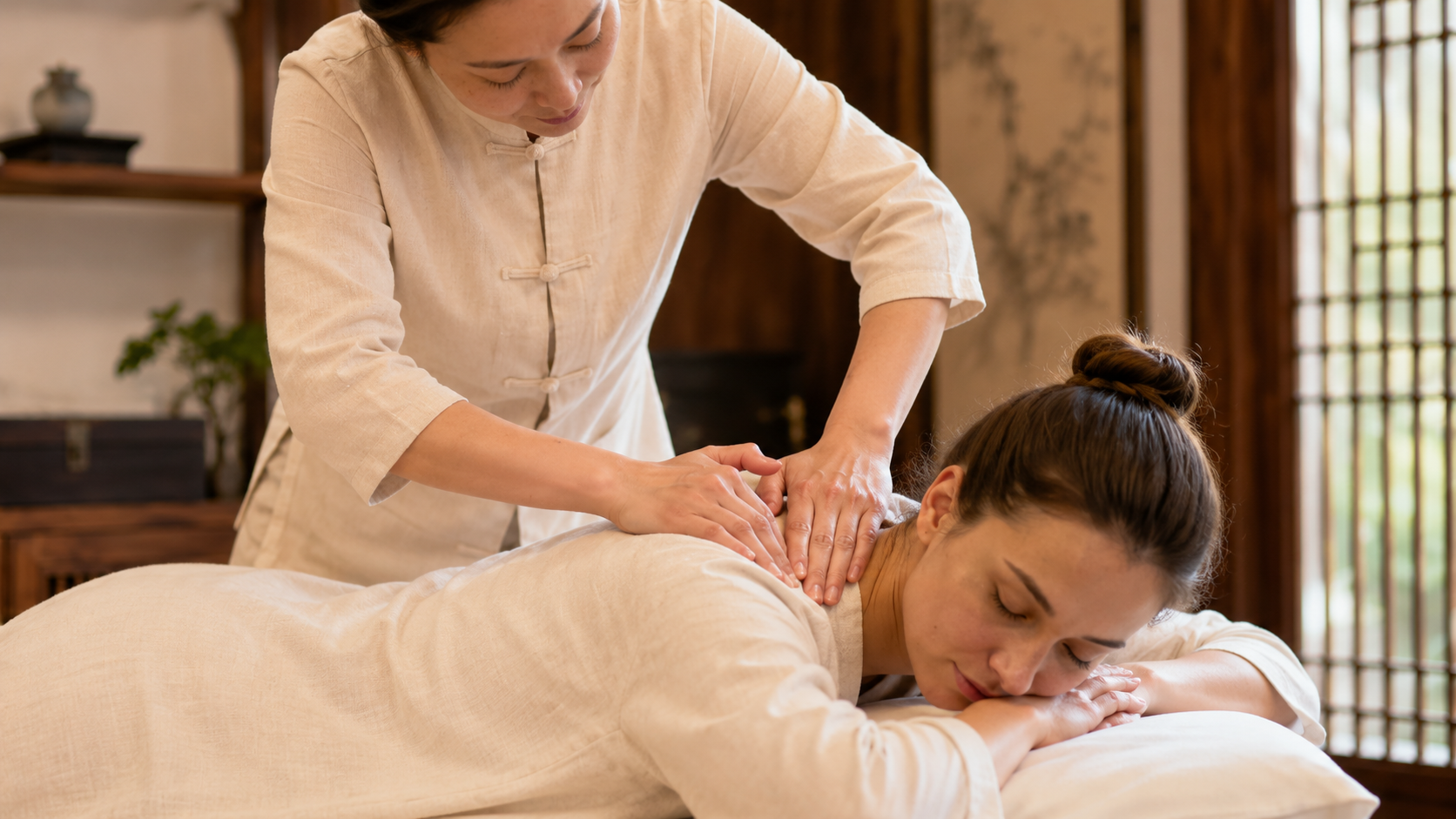
When traveling in China, in addition to the Great Wall, the Forbidden City, the ancient water towns of Jiangnan, and Chinese cuisine, there is another distinctly Chinese experience that may not appear on the first page of ordinary travel guides—Chinese tuina.
For overseas visitors accustomed to Western-style massage, spa treatments, or aromatherapy massage, Chinese tuina often brings a completely different feeling.
If you have walked all day during your trip, spent a long time on a high-speed train or airplane, or simply want to try an experience closer to the traditional Chinese way of life, you can consider scheduling a professional tuina session.
What is tuina?
“Tui” and “na” were originally two common manual techniques, but today “tuina” has become one of the general terms for traditional Chinese manual therapy and body conditioning methods.
In China, tuina has a long history of development. Traditional theory usually selects techniques based on the body’s meridians, acupoints, and the condition of different body areas. In modern clinical settings, tuina is also often assessed and performed in combination with muscle condition, joint range of motion, soft tissue status, and the patient’s specific symptoms.
Therefore, the “tuina” you encounter in China may take several quite different forms.
Some are more oriented toward daily relaxation, similar to a massage experience; others belong to Chinese medical tuina in hospitals or medical institutions, where professional medical staff address problems such as neck, shoulder, lower back, and leg issues.
For ordinary travelers, if you simply want to try it, choosing a reputable health management facility, a professional tuina center, or a Chinese medicine medical institution with clear qualifications is more appropriate.
How is it different from a regular massage?
For those experiencing Chinese tuina for the first time, the most obvious feeling may be that it is more targeted than an ordinary relaxation massage.
Western spa massage often places more emphasis on comfort, rhythm, and overall relaxation, sometimes using essential oils and creating a quieter environment.
Chinese tuina, by contrast, often focuses on specific body areas. For example, if your neck and shoulders are very tight, the practitioner may spend more time working on the trapezius, around the shoulder blades, and the neck; if you have walked a lot during your trip, they may pay more attention to the lower back, hips, and legs.
Styles vary among practitioners, so before you begin, you can discuss your specific concerns in detail with the tuina practitioner, for example:
- Which area is most fatigued;
- Whether you have any old injuries or recent injuries;
- Whether you prefer lighter or stronger pressure;
- Whether there are any areas you do not want touched.
If the pressure feels too strong, you can ask for it to be reduced at any time. If you feel discomfort or pain during the session, be sure to tell the tuina practitioner immediately so they can explain or adjust the technique.
Why is it suitable to arrange during your trip in China?
For most people, long-distance travel is by no means easy.
Walking 10,000 to 20,000 steps a day, queuing for hours at attractions, sitting for long periods on airplanes, high-speed trains, or buses, plus jet lag and unfamiliar sleeping environments—many visitors begin to experience neck and shoulder stiffness, lower back fatigue, or sore legs after a few days of travel.
At such times, a comfortable tuina session can become a “rest stop” during your trip.
It does not have to be a formal medical treatment. You can easily arrange it in the evening after hiking the Great Wall, after a day exploring Suzhou’s classical gardens, or after arriving in your next city by high-speed train.
Compared with rushing from one attraction to another, setting aside an hour to experience a local form of body relaxation is itself part of getting to know life in China.
What is a Chinese tuina session like?
The tuina practitioner will use their palms, fingers, thumbs, forearms, and so on to perform techniques with varying pressure and rhythm. You may feel pressing, kneading, rolling, pushing, stretching, and focused point pressure on certain areas.
Some areas may produce a noticeable sore or distending sensation, often described in China as “soreness, numbness, and distension.” But pain is not necessarily better when stronger. If you feel clearly uncomfortable, tell the practitioner promptly.
After the session, some people feel more relaxed in the neck, shoulders, and limbs, while others may feel slightly tired for a short period. On the day of your session, you can drink plenty of water and avoid arranging very intense exercise immediately afterward.
What is the difference between tuina in hospitals and tourism-oriented tuina experiences?
This is very important for overseas visitors. In China, many large hospitals have tuina departments, acupuncture and tuina departments, or Chinese medicine rehabilitation departments. Tuina in these settings is part of medical services and is mainly intended for people with clear health problems, such as certain types of neck, shoulder, lower back, and leg pain, musculoskeletal issues, or rehabilitation needs.
In contrast, the tuina that travelers experience in commercial establishments is more of a health and relaxation service, and the two should not be confused.
If you are simply tired from traveling and want to experience Chinese culture, you can choose a reputable, relaxation-style tuina session.
If you have persistent pain, a sports injury, joint problems, a postoperative condition, or another medical issue, it is more appropriate to be evaluated by a doctor first before deciding whether tuina is suitable for you.
When Is Tuina Not Recommended?
Although tuina is a common way to relax the body, it is not suitable for everyone or in every situation.
If you have recently experienced significant trauma, a fracture or suspected fracture, acute inflammation, severe swelling, broken skin or infection, or if you are still in the surgical recovery period, you should not receive forceful tuina on your own.
People who are receiving cancer treatment, have certain serious cardiovascular diseases, blood clotting problems, or other complex conditions should also consult their doctor first.
If you wish to receive massage or tuina during pregnancy, you should also inform the staff in advance and choose a professional with relevant experience.
If you are not sure whether your physical condition is suitable, consult a doctor first.
Add Tuina to Your Health Trip in China
Travel does not have to be just rushing from one attraction to another.
In China, you can also get to know the country in another way: drink a cup of Chinese tea, visit a local market, take a tai chi class, or try Chinese tuina when you are tired from traveling. These experiences often have no grand landmarks, but they are closer to everyday life in China.
If you are planning a health trip to China, we can help you find reputable tuina, traditional Chinese medicine, and health management services suitable for international visitors, based on your itinerary, city, and personal needs.
Whether you simply want to relax during your trip or hope to learn more about traditional Chinese medicine, you can add a tuina experience to your China itinerary. It may become an unexpected yet distinctly Chinese memory from your entire journey.
If you have any ideas, feel free to talk with our customer service or health planner. We are always happy to communicate with you.